Showing posts with label journals. Show all posts

Thursday, August 27, 2009

Bix’s Mémoires: Afternoon in Hiroshima, August 3


Following our visit to Miyajima we returned to Hiroshima in order to meet with Steven Leeper at the Hiroshima Peace Memorial Museum. Steven is an American who is the Chairman of the Board of the Hiroshima Peace Culture Foundation. It’s the first time in its history that anyone not Japanese has been given that position. He and his wife have been in Hiroshima 40 years and he is deeply respected by the Japanese as well as by all nationalities. He is very insightful, articulate and charismatic.

After arriving at the Peace Museum we were ushered into a meeting room by his secretary. After a brief introduction he began by answering my question about what is happening to prepare for the Non Proliferation Treaty review which will take place in May of 2010 at the United Nations Building.

Steven left no doubt about the vital importance and urgency of the N.P.T. Review Session which will be held in May 2010 is to set definite dates for the abolition of all nuclear weapons in our world. Every 5 years the Non Proliferation Treaty nations (138) hold a Review to assess how well they are doing in moving toward nuclear weapon abolition. The international body of Mayors for Peace which has 3000 members of which Mayor Akiba of Hiroshima is president has helped to draft the accord which calls for the elimination of nuclear weapons from our earth by 2020. The agreement by all nations to abolish their weapons and the plans on how this will be accomplished must be in place by 2015. These goals and dates are known as the Hiroshima-Nagasaki Protocols.

Leeper fears deeply that if this doesn’t happen at the N.P.T. Review in May, 2010 then it won’t be long before poor nations will arm themselves with nuclear weapons. When that happens it is only a matter of time before a nuclear exchange will take place.

Steven said many other things but these were the words that I understood and felt great urgency about. He summed up his urgent message with “this is crunch time” the advice to listen was well advised.

We heard from the townspeople of Iwakuni about the local effects of American military supremacy. Now we heard from the Chair of the Hiroshima Peace Culture Foundation about the global consequences of not acting.

Wednesday, August 26, 2009

Bix's Mémoires: Journey of Repentance, August 3rd (Morning in Hiroshima)

I will skip to the fifth day of our journey. We had flown from Tokyo into Hiroshima and were met at the airport by Fr. Juan Catret, S.J., an associate pastor of the Catholic Church in Hiroshima. He had provided two dormitory style rooms with air conditioning for the men and the women. Through clerical custom, Louis Vitale, a Franciscan Priest and I were given separate rooms, custom prevailed over protests.

Fr. Catret was amazing. He accompanied us where we went and was a companion, tour guide, translator and conflict resolution person all while we were there.

He invited any that wished to join him for mass on August 4th. I concelebrated with him and the Japanese pastor and co-pastor. While we were sitting during the readings the rain storm outside picked up force and became a deafening down pour. Through the open window I saw the down spout became a rising geyser with the water gushing high. As it continued I had the thought that God is still crying in Hiroshima.

After a breakfast that was prepared by Demetra Schweiger and her daughter, Allyson and Teresa Montes,O.P., we took off for Iwakuni. Iwakuni is the site of a U.S. Marine Base and air field. The people of the town have been protesting its presence for over 30 years. It is not only that they feel still occupied (U.S. occupation ended officially in 1952) but the constant landing and taking off of Marine and Navy air craft causes terrible noise pollution in the city and neighborhoods. At present the base is adding an extra runway to increase the air traffic potential. The Government of Japan pays 70% of the cost of maintaining the U.S. base and paying 70% for any additions or improvements.

The Iwakuni Marine Base and all the other military bases in Japan and Okinawa are a contradiction and a threat to Japans Article 9 of their constitution. Article 9 states:

Aspiring sincerely to an international peace bases on justice and order, the Japanese people forever renounce war as a sovereign right of the nation and the threat or use of force as means of settling international disputes.

In order to accomplish the aim of the preceding paragraph, land, sea and air forces, as well as other war potential, will never be maintained. The right of belligerency of the state will not be recognized.

Though it is hailed as a model constitution, there is pressure from our government to change Article 9 to permit deterrent forces and there is pressure by some Japanese government officials to bow to the need to arm themselves against threat – e.g. North Korea.

The Iwakuni peace league arranged an outside tour of the base for all of us. We were joined in the town by Marc Milsten, a PLU graduate from Tacoma, WA who was teaching English at the Ohno Higashi Junior High School near Iwakuni. He had read about our journey on line and contacted us before we left the U.S. He was accompanied by the main instructor of English at the junior high, Kay Domen. She was born and raised in Hiroshima.

As it turned out she became our translator on the tour of the base.

We witnessed the new construction going on and the constant take offs of the marine air craft. Each air craft take off was a reminder that American might still prevails.

After the tour we gathered for a sumptuous luncheon prepared by the townspeople. We were feted and treated as royalty. After the meal there was the exchange of gifts. The gifts of our hosts were always valued, artistic and heart felt. Joan Staples was our main gift presenter throughout our Journey. She was assisted by Debra Covert-Boles and Denny Moore in making gifts of Dream Catchers, Ground Zero T Shirts, books and calendars brought by Leslie Klusmire.

Then song prevailed as Steve and Kristi Nebel sang from their repertoire. Some of the songs were familiar – some were new. “When Johnny Comes Marching Home Again” sung by Kristi was new to our Japanese hosts where as “Blowing in the Wind” was known. The entire Iwakuni luncheon hosts joined in chorus for some songs of their history. An elderly man played the guitar and sang. We all joined together to sing, “We Shall Overcome.” We made our good byes and got on the train for Miyajima.

Miyajima is the most visited tourist spot in Japan. In the bay outside the city is the most famous Shinto Shrine & Emblem of Japan. We took a ferry to the island which borers on the bay inlet in which the shrine is built. It was a hasty trip on our part and we did not do the shrine and surroundings justice.

Monday, August 24, 2009

Bix's Mémoires: Journey of Repentance, July 30, 2009 – August 11, 2009

The original intent of our Journey of Repentance was to apologize to the Japanese people for the atomic bombings of Hiroshima and Nagasaki. At that time it was not clear in what venue or to what body or person(s) the apology was to be made. The feeling was unless the American Government or Americans apologize, the United States would continue to threaten other nations with its nuclear weapon superiority and use its military might to solve its international disputes.

We have military bases around the globe to reinforce our demands when we are threatened. The reliance on this type of diplomacy is to be caught in the bondage of violence – a violence that will eat away the heart, mind, soul and body of our people. Nuclear superiority, arising out of the horror of Hiroshima and Nagasaki, is the Midas touch that will bring the U.S. to crumbling ruin unless it begins by rejecting nuclear weapons.

Through apology, it was envisioned that our group would commit itself to work (more) deeply for nuclear weapon abolition.The Journey of Repentance had grown to 18 people.

Before we left for Japan we received an e-mail from Steven Leeper stating that Mayor Akiba of Hiroshima, who is president of the international Mayors for Peace, did not agree with apologies. He preferred people to see themselves as world citizens who would work to abolish nuclear weapons as a threat to our common human family. The mayor strongly urged all people to listen to the testimony and experience of the Hibakusha (survivors). They have come through their incredible suffering where once they envied the dead about them to now giving their lives as a non-retaliatory (non-violent) witness to end nuclear weapon attacks and eventually all war. The mayor pointed out that the Hibakusha have kept alive the possibility of a world without nuclear weapons for 64 years. They are the well-spring and a fount of pure water from which and to drink and to bring hope to people for a world free of nuclear weapons.

He also emphasized his contention that all people make mistakes, and that we as human beings accept the fact of our making mistakes in accepting one another. His observation has come out of his experience of the survivors not holding retaliatory or blaming attitudes – but rather they have grown into non violent witnesses to the need for all people to accept one another.

We changed our focus from apology to listening. Listen to learn. It did not become as urgent to apologize. The feeling of sorrow and even horror for what the U.S. had done and the resolve to work for abolition of nuclear weapons was still present and became strengthened by experiences of our journey.

Tuesday, August 18, 2009

Day 1 & 2 from Steve & Kristi

Thursday, July 30th - It was all day travel to Tokyo arriving at 3:30 pm on the 31st @ 3:30 pm. I was spacey from travel, and forgot that I had put my cash in my money belt. I used an ATM to get cash, and also converted some cash. We never had money problems.

The trip into Tokyo on the train was exciting. That was in spite of the fact that we’d been traveling for a long time, and were all falling asleep. I noticed bamboo forests along the tracks, and large expanses of rice fields interspersed with indications of approaching urbanity.

Our hotel room was about 15 X 15 with windows that really didn’t want to open. There was a small refrigerator, and a small TV. The beds were thin cushion mats, and the floor was of woven straw (or could it have been shredded bamboo?), called tatami mats. We had been cued on taking off shoes, so were barefooted in our room. We mostly crawled around the room, very seldom actually standing up. My knees, and other joints adjusted to this reality while we were in Japan.

Saturday, August 1st: In the morning we all woke up really, really early. We were out by 4 am. By 5 am we were at the Tsujigi fish market. By 9 am we were back at the hotel. Joan, Karen, Kristi and I went shopping late morning, early afternoon. We found a department store to visit. The main thing we did on this day was meet with the Japan Peace Committee.

It was good to be in Tokyo first, and have some time to get used to the idea of being in Japan. The neighborhood where our hotel was was hardcore urban. Kristi and I never did get to some of the sights that were around there. I could guess that everyone had a different experience in Tokyo, and that was probably true of the entire trip.

The walk to the fish market was informative. We were typical tourists. We were called on for standing in the middle of sidewalks, and also we found ourselves in a place of business (fish biz) standing where people were trying to work. Our friend, fellow traveler, Mitch Kojima interpreted some of the irritated comments of the people we interfered with. (From Kristi): If the entire business had been filmed from the ceiling it would have looked like a movie set to fast-motion with a group of idiots trying to stall the pace. We were the idiots.

On the schedule that we were on, the days were exceedingly long. Food was our individual responsibility. Of course that first day was all a learning experience. The restaurants had pictures of the food they were serving, which were plastic representations of the food. It really didn’t convey the information needed to make a decision without being able to read Japanese. They had vending machines that you put money in that gave you a little ticket that you handed to the waitress, who gave the ticket to the cook. You ordered beverages directly, or there was a water dispenser as well, and you could just serve yourself water. It was a pretty efficient way for a restaurant to run, when the clientele doesn’t speak your language. I just gave up on being any kind of vegetarian for that period of time. (From Kristi): Most of what I ate was unidentifiable to me. The ubiquitous pickle in particular appeared on every plate in varied forms of vegetables which I imagine don’t grow here. That said it was all excellent and I did NOT lose weight in spite of walking blisters into my feet.

Kristi and I had to find wrap for the CDs, which were supposed to be gift wrapped. We also needed scissors, and tape, and ribbon. There was a substantial market place just across the big boulevard from the area where our hotel was located. It took up several streets, and was maybe a half a mile long. There were buildings. It was like an outdoor mall. There were guys selling fish, and drugstores, and jewelers, and shoe stores. There was no gift wrap though.

The department store we finally found had a little of everything. The basement was a grocery store. The ground floor had specialty foods, and clothing. There was more clothing on the second floor, and the third floor was almost all booze. The fourth floor had what we were looking for. We did buy some Japanese whiskey though, as well as tape, scissors, ribbon, and paper. Karen, Joan, Kristi, and I did well at splitting up, and finding each other once again. I think we all had fun in the department store.

(From Kristi): We joined the group later and made our way to the headquarters of the Japan Peace Committee. The group formed around sixty years ago and has a membership of 30,000 in groups throughout the country. They sat us at tables set with a meal of hors d’oeuvres and set out to formal introductions with all. We listened to speeches from their leaders and one by one each of us spoke briefly about our intentions regarding our trip and nuclear disarmament. The Japanese are coming closer and closer to reversing Article 9 of their constitution which demilitarized them offensively; an election forthcoming will soon decide the issue. Japan, to my way of thinking, took the most wise and prudent course of action in response to our own nuclear barbarism of 1945. Would that all nations have followed their lead with Article 9; then our job as peace advocates would have been aborted long ago. Our meeting began to end with mutual favors exchanged. As is the custom, we gave wrapped gifts and received them. Our group gave teeshirts and Native American dream-catchers. They gave each of us fans. We began to exchange cards and friendly conversation. Then a wrapped large card-like gift was given to Bix. He boldly opened it, probably at the urging of the giver. Inside was a drawing of a beautiful human face inside a dove. Underneath was an inscription to the Japan Peace Committee, signed and dated by Pablo Picasso. Bix joked, “Oh boy, now I get a new home! “ It occurred to me that the custom is to reciprocate with a gift of equal value. So maybe all of us delegates now should sign over the titles to our houses to the Japan Peace Committee.

Sunday, August 9, 2009

Last Day in Nagasaki

Yesterday, some members of the group went to a liturgy (more on that later) while others who were "Catholic-ed out" attended other events. Kristi, Steve, JoAn, Debi & I (Sarah) went to the peace convention that started in Hiroshima and concluded on Nagasaki Day. Attending the convention these past three days, we've been pretty inspired by the powerful anti-nuclear movement here. The youth are amazing and very enthusiastic with their vision and perseverance to achieve a world free of nuclear weapons. It's been interesting to talk with delegates from other countries, both young and old, about the anti-nuke circumstances in various parts of the world. We are all dedicated to this cause. To join together with others, to have some rallying time without the apprehension that is more abundant back in the states, is very motivational. As almost every speech-maker of every nationality mentioned over the course of the convention, "yes we can."

Many group members had a chance to visit the Nagasaki Atomic Bomb Museum yesterday. This was quite an impacting experience. The first room of the museum is a model of the rubble left after the bomb exploded and includes a model of one side of the very church that many members would visit - it has since been remodeled. Urakami Cathedral was a majestic building that, like the area around it, was completely destroyed by the H-bomb dropped on August 9th, 1945. Although it was smaller than the Hiroshima museum, this one was just as effective. It displayed many artifacts from the aftermath of the bombing. Item after item - and they were simlar things, like clothing, roof tiles, etc. Seeing these things and their accompanying stories over and over really pounded it into my brain. We, as humans, must not do this again. Not to anybody. It's not a matter of nationality, politics, religion, or power.

Last night at 6:30, Bix, Louie, Teresa, Leslie, Denny and Tom attended a Catholic liturgy at the Peace Park here in Nagasaki. Severral thousand people marched from the park following the liturgy - each received a bamboo torch. The lighted torches were carried in procession to the Urakami Cathedral several miles away in the dark for the mass at 8:00. The quiet procession was a spectacular sight. The commemorations moving - a small sense of solidarity with the people of Japan who have suffered so much - also a sense of great hope to work to never let this tragedy occur again.

We leave in one day to return to the United States. Our journey here has been more than we could have ever imagined. The hospitality, gentleness, and respectfulness of the Japanese people - hibakusha (bomb-affected people), inspirational youth, many people who have generously provided shelter during our stay, taxi drivers, strangers on the streetcars- is beautiful and a powerful sign of non-violence in a world where reactionary sentiment sometimes seems hopelessly common. We are eager to come home and express our gratitude to all who made our journey possible and to share what we've seen and heard.

-Tom & Sarah

Saturday, August 8, 2009

On Human Sin and the Nerves of Uncontrolled Females


"So you are Catholic?" He asked me.

"Well, no."

"But CERTAINLY you are a Christian?"

"umm...."

Which is when his hand found its way to my forehead, and I was told that Father Diez, who I just met five minutes before, would be praying for my soul to find Jesus, and that when I return home I should then start attending church.

It became clear early in our stay in Nagasaki at the Jesuit retreat center that there had been a misunderstanding. After several non-Catholics in our group encountered conversion attempts, and almost all of the women had been either insulted and/or ignored, we realized that perhaps when these Jesuits offered us housing they did not read about our group past the title of "Journey of Repentance." Our hosts were quite certain that we were not only all Catholic, but that our purpose here in Nagasaki was to attend mass at the monument of the 26 Martyrs and retreat at their center, rather than attend conferences, listen to the Hibakusha, and take part in interfaith ceremonies. They were shocked and angered to discover the misunderstanding, which we felt we had made clear from the start. Fr. Jose then explained to me the belief among a large sect of the Catholic community here that God offers the "only" answer to why Nagasaki was bombed: it was His punishment for human sin, that the lives brutally lost on August 9th were a human sacrifice. Even the Catholic members of our delegation were taken aback; these are not the Catholics we are used to and familiar with. It is clear that both groups have much to learn.

All the same, efforts have been made to ease the discomfort and discontent. We do not want to leave ruffled feathers, we do not want to leave with anyone feeling insulted. Misunderstandings have been felt on both sides, both religiously and economically. We were under the impression that they had offered us housing as a gift, much as the Guadalupe House has done for all those who pass through it's doors on retreat for this cause. However, we have been corrected and are now charged 4,700 yen a night per person. Reviewing the situation, we decided that the money was not our greatest concern. As Tom put it so well this afternoon, it would be hard to host an interfaith group focused on dialogue with the Hibakusha in a place where non-Catholics are seen as potential converts, women have no voice, and any effort to speak with the Japanese survivors of "God's punishment" is seen as "not important." We attempted, and succeeded fairly well, to hold reflection time this afternoon, which was interrupted by a reprimand from Fr. Diez on our practices with the air conditioning. Just last night we were talking about how impressed we were with all the hospitality we have received in this country. Clearly the hospitality at this particular location has come to an end. Luckily, the Buddhists down the street have room for us, so we switch roofs tomorrow. Perhaps it is the lack of sleep, but I find it amusing that the Jesuits kick us out and the Buddhists open their doors. What an image. What a world. What a Nagasaki.

In spite of all these logistical issues, we have made much progress since arriving in Nagasaki, fueled by all we encountered and learned in Tokyo and Hiroshima. Today, 8 of our members attended the 2009 World Conference against A and H Bombs.The other 10 remained at the center to reflect on our experience thus far and plan for the nine months that lie ahead of us in preparation for the NPT Review Conference. May 10th, 2010 will come sooner than any of us can imagine.

But, before it gets here, get ready for panels, exhibits, music, pod casts, a documentary, lobbying efforts, letter writing, and guest Hibakusha speakers. As each mayor of Hiroshima has made clear since 1945, the time is NOW to put an end to nuclear weapons. Tomorrow is the 64th anniversary of the bombing of Nagasaki. We are hopeful that August 9th will forever be known as both the second, and last, atomic bombing.

Thursday, August 6, 2009

Oh Healing Waters


The Hiroshima Peace Park was more crowded than it has been on any of our visits yet. 50,000 people gathered from all over the world, laying cranes at each of the monuments, singing songs of peace, handing out information (most in Japanese), and most importantly being present at the Hiroshima City Peace Memorial Ceremony.

Mayor Akiba announced the Hiroshima Nagasaki Protocol, and called to an end to nuclear weapons by 2020. A flock of doves flew overhead. Two children rose and spoke of the struggle it takes to bring a child into this world, and of when a life is lost. Speaker after speaker told us the same thing: the time is now.

In a horde, we left the Ceremony for the Peace Pole, where a hopeful group prayed for peace to prevail in each country, with crowd members walking forward with flags to represent each. Afterward, Tom rose and gave a speech about our purpose here, and Teresa and Kristi presented 1,000 cranes. Another 1,000 cranes, folded by children from Tacoma, were left at the monument dedicated for children mobilized in the war.

At a Hibakusha listening session in the afternoon, we were told by a woman who was 8 years old when the bomb was dropped on Hiroshima that the "first step of peace making for [us] is to listen, and for the survivors it is to tell their story." She told us that after the bomb dropped, refugees began to come toward her home, and her family took them in. They begged for water, and she brought it. After they drank, they would die. She told us that she has lived with a guilt, a fear, for the last 64 years. She thought for the longest time that she had killed them by giving them water. She also told us that she has tried to tell her story before in the US, and was confronted by hatred in both the form of words and stones. She spoke of a great fear that all Hibakusha feel. And we morned that when she tried to share with others from our country, we only made that fear worse. Somehow she found the strength to keep sharing, and began an organization called Interpreters for Peace there in Hiroshima. She said that "people ask how the Hibakusha can be strong, it is because we live on behalf of the dead."

I left the listening session, and the morning`s activities, feeling both hopeful and full of sorrow. These extremes were only heightened when we went to a Buddhist temple for a ceremony and dinner. They welcomed us with the most sincere smiles, seemed genuinely happy to be sitting there with us. Us. US. I cannot help but feel, regardless of Mayor Akiba`s wish for us not to apologize because we should not associate ourselves with a country in such matters, a deep sense of regret at our actions. How could we drop the bomb? How could we drop another just days later? How could we still continue improving the capability to do so again? And further, how on earth could the Japanese continue to show such warmth, such generosity, such hospitality?

Once again I found myself in need of something to cheer me up, and it did not take much looking. After the ceremony ended, the monks and nuns pulled away the cushions to set up tables, and began setting packaged meals and beer out for the group to enjoy. We sat to eat, and began by chanting "nam myoho renge kyo." The monks, simultaneously chanting and pouring us beer. What an absolutely incredible country, what absolutely incredible people, what an enjoyable religion!

We were sent off with sacred beads and a smile on our faces, attempting to emulate the warmth of our hosts. On we went to our final event in Hiroshima: the Floating Lantern Ceremony. When we arrived, the ceremony was already well on its way, as lanterns floated down the river past the A-Bomb Dome. Music played in the background, light fell, and thousands walked down to the riverside to place a lantern in the water, watch it float away, and pray.

Healing waters
Healing waters
Solace flows through the river of forgiveness to my soul
Oh, I need You
Healing waters

Wednesday, August 5, 2009

"There is just no reason."


Bix forgot to put his charged batteries back in his camera this morning, so as we approached the A-bomb Dome I handed him mine to snap away on. Turns out, after years of trying to get him familiar with technology (which it seems he keeps away with a ten foot stick), he loves taking digital pictures, and then reviewing the results with a combination of delight and surprise. We handed the camera to another visitor, asking them to take one of us together, then they requested that we reciprocate. As I took their camera and began to frame our new friends against the skeleton of one of the few surviving buildings from pre-1945, I heard Bix's voice ask, "um... Tamara?" Upon glancing his direction, I knew immediately the situation he found himself in, and one of the few situations he will ever ask for help with: another pair of visitors had asked him to take their picture, and handed him an advanced digital camera with a flash and lens attached. "Tamara? Could you, maybe?" he asked. Perhaps Bix`s new found love for pictures only goes so far.

That is the joy of traveling to Hiroshima with Bix: we find ourselves surrounded by stories and pictures and the reality of humanity`s worst mistake, find ourselves buried in sorrow and unable to see how we can recover, and yet somehow Bix can still make you smile, help you laugh easily. I needed that help very much today.

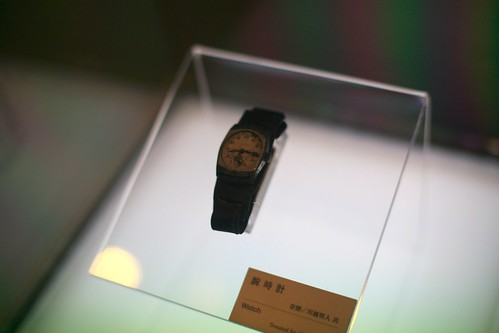
We left the A-bomb dome and walked across the Peace Park to the Hiroshima Peace Museum, where we paid our entrance fees and rented audio guides in English. Bix and I debated last night how long it would take to go through the Museum; I bet one hour, he bet four. Although he was technically right and we did leave after four hours, I think perhaps we were both wrong. We could still be walking through that exhibit right now and not have had enough time. I wish I could explain. I wish I had words that could help you feel the way that I felt, looking at a watch frozen forever at 8:15am, at the binoculars used by the Enola Gay, reading letters written by the Mayor of Hiroshima each time another country tested nuclear weapons, watching a video of the mushroom cloud, standing over a replica of the city before, and then after, the bombing. I wish I could explain, but I can`t. Perhaps soon, perhaps never. All I know is, I would not wish that on my worst enemy. Hell should not exist here on Earth, and what we did to Hiroshima and Nagasaki was so much worse than hell.

Outside of the Museum, Bix stopped dead in his tracks and turned to me with anger on his face, "There is just no reason" he said. "There is absolutely no reason for us to still have the capability to drop those bombs."

Our delegation met up again at the A-bomb Dome, then left by street car to the Peace Cathedral where we took part in the Catholic Symposium on nuclear weapons. Six priests sat at tables in the front of the Cathedral to present their thoughts (I wont even get started now on the lack of women we saw represented throughout our time today at the Cathedral... don`t get me started...). A few key quotes and highlights:

Fr. Bob Cushing: "The art of peace making is in the sharing of the journey that we take together right now... We in the US struggle with an inability to be honest about the past... Those who are persecuted for justice are indeed blessed."

B.P. Matsuura: "Now is the time to find a new way for us to live together in peace."

Fr. Koezuka: "There has been a great swelling of movement against nuclear weapons due to Obama`s speech. But he said that he probably wouldn`t see it in his lifetime. Some Japanese respond to this speech by saying that they have been protected by the nuclear umbrella so not to take it away... My belief is very simple, but I cannot take my attention away from the fact that August 6th, 1945 was a turning point in human history. It showed us that we have the ability to destroy each other completely."

Following the symposium we crossed the courtyard to take part in a listening activity with a Hibakusha. The room was packed, and I found myself sitting in the hallway listening, rather than seeing and fully experiencing, the story. Ashley mentioned afterward that even though she did not know what the woman was saying, as it was in Japanese, that there was a moment when everyone in the room began to cry, so she too began to cry.

As I sat in the hallway, one of the reporters who we`ve been talking with while here came and sat with me. He asked what I had thought of the Museum this morning, and I gave him my inadequate attempt at describing the indescribable, the unimaginable. He then responded that even for him, the first time he went to the Museum, there were no words. He still couldn`t believe what had happened, it was just too terrible.

It`s one minute to midnight here, one minute to the day when, 64 years ago, the first atomic bomb was dropped. This time, 64 years ago, a small handful of Americans knew that in 8 hours and fifteen minutes, something terrible would occur in Hiroshima. This time, 64 years ago, 140,000 people were sleeping, eating, working, and living, not knowing that in 8 hours and fifteen minutes their lives would end in a feat of violence like none we have ever experienced.

"There is just no reason."

Tuesday, August 4, 2009

Teresa pulled herself out of bed this morning at 6, willingly she said, to attend mass at the church where we are staying. I, attempting to capture her grace, got out of bed as well to have a second round of arguments with the dryer which holds captive all of our clean clothing.

Demetra and Alyson laid out our breakfast. Yesterday they, along with Steve and Kristi, went to the store and brought home the ingredients for a little bit of America – spaghetti, watermelon, salad. For breakfast they had yogurt, fruit、and toast, which we made in a pan on the stove. It was glorious.

We gathered in the courtyard to head out for a long day of peace making. As is the case with most such days, it was raining. The benefit of the rain in Hiroshima though is that it hides the sun, and we are able to walk a little farther and climb a few more stairs before being overwhelmed by the heat.

Iwakuni Marine Base was our first destination, where we toured the perimeter then met with the community members of the Japan Peace Committee. After a delicious meal, which the Women’s Committee prepared for us, we left for Miyajima Island, then headed to ground zero to meet with Steven Leaper, director of the Hiroshima Peace Museum.

Steven is the first American to be director of the Hiroshima Peace Museum, but didn`t take long for us to realize why he had been given the honor and responsibility. He described our current situation as “crunch time,” that “when it comes to nuclear weapons, next May we will decide as a species whether we will rid the world of nuclear weapons or five them to everyone... The Hiroshima Nagasaki Protocol is the only viable proposal on the table... The key question is, what is the human race going to do about nuclear weapons?” We walked out of the boardroom nodding our heads, smiling, and saying “yes, that`s it.”

Sunday, August 2, 2009

The more the better!

We were all put immediately at ease with the Provincial, Fr. Adolfo Nicolas S.J.; he was very welcoming and gracious. The others meeting with him were Louis, Leslie, and the woman who kindly drove us, Mijumi and her daughter. We talked for an hour in a well set out board room, and he was very interested in how and why this group came together. He thought it was the first group in such a vein to come and express such deep sorrow; however, he was supportive of our mission.

I felt good to make this contact. His residence is at Sophia University, a very prestigious university in Japan. Sophia is not known for it`s active involvement in social justice however.

St. Ignatius Church is in that complex, so after the meeting we went to Mass by an Irish Vice Rector named Doyle, where there were around 800 people present. People came out of the mass and I was amazed at how many were there - particularly the young people, just scores and scores of young people.

Afterward we went to the Jesuit residence and grabbed lunch, and as before we had been wandering around Tokyo looking for distinguishable food, here we had a delicious meal provided for us.

This meeting falls into the social justice aspect of the group, as we need a deep connection with Japan through their universities. We need to get the Jesuits involved, particularly in the international issue of atomic weapons. The more interaction we have with them the better it is for action across the local and global scene.

- Bix

Hiroshima Panels

"Oh - even the baby would rise again, and on its feet toddle around, IF peace came."

This line came from a poem accompanying one of the Hiroshima panels we traveled to see yesterday. The artists portrayed well the destruction, suffering, death, and despair of the people of Hiroshima on the dropping of the A bomb, August 6th 1945. From the darkness, blood, fire, chaos of this hell, I tried to imagine being there. I went one step further and saw the spirit of the people rise as they exclaimed - Please, no more nuclear bombs! Peace please!

"The atomic bomb exploded on human hearts as well as upon human bodies."

We will arrive in Hiroshima today and prepare to be a compassionate presence to the Hibakusha, to remember with them 64 years ago, to try to perhaps bear the burden of pain for those who lived here.

I am so very honored to be with this group of people who have worked so ardently for peace.

- Demetra

Saturday, August 1, 2009

Peace by Picasso

We have arrived safely and settled into Tokyo, experiencing a whirlwind of food, ceremony, music, and subway in the last two days. While landing, uncharacteristically (as I am terrified of flying), I opened my window to watch. "1 minute to arrival" the screen in front of me said, yet all I could see was a dense fog. Seconds from landing the fog cleared to reveal lush green countryside as we touched down. Welcome to Tokyo... well, almost. 70 minutes of train later, after watching the scenery change from vibrant green to vibrant neon and flashing lights, we stepped into the largest city in the world.

First impressions of Japan ranged from surprise at the cleanliness and full recycling bins, the eagerness of those we have met to smile, the beauty and lack of obesity, the abundant sense of style, the box walls built each night by the homeless to surround their sleeping mats. But common among all of our first impressions was a sense of awe at the kindness shown to us. The woman in a noodle shop who, though she did not work there, delivered water to Demetra and Alyson. The hotel owner where we are staying offering his own computer and printer for me to use when I could not find an Internet cafe with printing capabilities, then feeding me shrimp crackers and tea while I used both. The staff of the corner shop, of Kinkos, of an Internet cafe, and of the police station who rushed forward to help Tom get in contact with his wife, Laura, when both our international phone and calling cards did not want to cooperate. Kindness has been shown to us at every step - that is our first impression.

Last night we had the privilege of meeting with the Japan Peace Committee, the oldest peace organization in the country. Upon sitting down to meet with them, we were presented with a wide array of sweets and snacks, coffee and tea, and asked to please enjoy. Three years ago, this very group visited us in Tacoma and Olympia, Washington, to organize support for the Non-Proliferation Treaty review which comes up this May, 2010. On this, our return visit, they welcomed us, and stated that they "are encouraged and empowered" to know that they are not along in their work against nuclear weapons. One representative stated that they "have no feelings of hatred toward American people, even the Hibakusha. But, [they] are very happy that people are coming from the US to help realize a world free of nuclear weapons." In spite of the language barrier, which our translator did much to minimize, both groups felt an immense connection.

There is something wonderful about realizing that people across the world who speak a different language and have such different customs can feel exactly the same about an issue such as nuclear weapons. As we prepared to leave, our groups exchanged gifts, and the committee presented us with several packages. In a wave of gratitude we hardly understood what was being handed to us. However, after exiting, we opened up a flat package, to find an original Pablo Picasso sketch of a dove with a face inside of it. Now, correct me if I'm wrong, but I believe in Japanese culture we are to, upon receiving a gift, return one of equal value? A request: If anyone out there has a priceless sketch by one of the most famous artists of all time that you'd like to send on our behalf to the Japan Peace Committee, please stand up.

It is August 2nd, four days to the anniversary of the bombing of Hiroshima.

Tuesday, July 28, 2009

Tom's Call to Conscience


Several participants in the Journey of Repentance were asked to share their perspectives on both the bombing of Hiroshima and Nagasaki, as well as the reconciliation and non-proliferation process. Tom Karlin, a leader for our group, provides his insights below.

Do you remember when you first heard about the bombings of Hiroshima and Nagasaki? How did you find out? What were your first thoughts? What was your reaction?

When I first heard about the bombings of Hiroshima and Nagasaki, I was only 9 years old. I do remember clearly the comments my parents made when the news came over our battery-operated radio. "They should have dropped one on Stalin right away." Like most Catholics and Americans, they believed in the "just war" doctrine.

What about the bombings most impacted you?

What impacted me the most about the bombings was what I saw 11 years later, visiting Nagasaki while in the Navy. At the epicenter of the bombing was a multi-story museum displaying thousands of relics, documents, and photographs. The whole display was poignant and ponderous... men, women and children trying to flee the inferno, terrorized.

What has your past involvement with nuclear non-proliferation been?

My past involvement with nuclear non-proliferation has been lobbying our representatives, letterwriting, attending rallies and marches, speaking at forums, and enacting civil resistance at the Trident Submarine Base at Bangor, Washington from the early 1970's, on. I have been arrested 6 or 7 times, and have done 4 months in federal prison once.


What is your opinion on nuclear proliferation? Is it at all influenced by your knowledge or understanding of the impact atomic bombs had in Japan?


My opinion on nuclear proliferation is that not only is reliance on nuclear weapons bad and violent policy, it is unlawful. The use, or threat of use, of nuclear weapons and the indefinite maintenance of a nuclear arsenal are contrary to established, universally recognized rules of international law.
Nuclear weapons and the threat of their use, is, in my opinion, terrorism. I believe the bombing of Hiroshima and Nagasaki, as well as the fire-bombings of 60 Japanese cities was a crime against humanity and also was a war crime, even if one embraces the "just war" doctrine.


What inspires you to travel to Japan for the Journey of Repentance?


What inspires me to travel to Japan with our delegation is the call of the Gospel to be peacemakers. I am inspired by the example of peace prophets like Gandhi, Dorothy Day, Oscar Romero, Martin Luther King Jr., Bix, and many others. Last but not least, the Japanese people, especially the Hibakusha, inspire me. ("Hibakusha": the people who suffered and are still suffering the effects of the atomic bombings.)

While in Japan, what do you hope to accomplish?
Along with my fellow travelers, I hope to accomplish the following:
^ Do a great deal of compassionate listening to the people we meet.
^ Express our deep sorrow for the suffering that our nation inflicted on them and ask their forgiveness, while also forgiving their nation for the suffering they inflicted on our people in the war.
^ Deepen mutual respect between our peoples.


Upon returning, what do you hope to do with your experience?

I hope that, upon returning, we can all in our unique ways and perhaps as a group share what we have seen and heard. I hope we thereby can contribute to healing, reconciliation and help peace break out, even in some small way, in our world.

Is there anything else you would like to share about yourself, your experience, or your intent for this journey?
After my discharge from the Navy in 1960, I entered the Trappist Monastery in Oregon. My novice master had been an aviator on a B-29 bomber that was involved in the fire-bombing of some of the 60 Japanese cities. While sharing my concerns, he encouraged me to become a conscientious objector to all war.

My "call to conscience" became so clear, I could no longer accept the Church's "just war" teaching. I became a conscientious objector to all war, and try to be a conscientious objector also to the things and activities that contribute to war. "Non-cooperation with evil is as much a duty as cooperation with good." -- Gandhi
In Luke's gospel, chapter 9, verse 54, when James and John wished to call down fire from heaven on their enemies, Jesus remonstrated with them: "You know not of what spirit you are. The son of man came not to destroy souls but to save them..." He also said, "Whatever you do to the least of my sisters and brothers, you do to me..." Matthew 25:40


Up north in Ferndale, WA, Sarah and Debi Covert-Bowlds have been receiving much support for the Journey of Repentance. The Ferndale Record Journal included a half page article about the trip (ferndalerecordjournal.com, 7/22/09).

Sarah was interviewed on KGMI Bellingham radio (KGMI.COM, podcast, 7/20/09) with an articulate and concise response to the mission and her individual reason for going as a 15-year old high school student. She answered that it was "crucial" that young people learn about the history of WWII, to learn from the history of all wars, to prevent repeating the mistakes and atrocities of the past, and emphasized the need to prevent the use of and work to abolish nuclear weapons. Sarah and Debi spoke of their trip's mission to their faith community of Zion Lutheran Church throughout July, and members folded origami peace cranes for them to take to Japan. A "love offering" from this small country church was received towards trip expenses.

On Saturday, 7/26, Debi and Sarah presented at a camp for children of migrant farmworkers, ages 6-11. The children were quite engaged by the picture book "Sadako and the Thousand Cranes" Sarah read to them, and they were very focused on the paper crane folding. They were shown photos of the Sadako peace monument in Hiroshima and told that the delegation would lay the cranes at this special place. One 10 year old told her friend who came late that Sadako died "by bombs we dropped." The emphasis was they all can be peacemakers even at a young age. One 10-year old boy declared camp for him was about having fun, and Debi replied that we can work for peace so that all children can have fun, because that is what all children deserve.

The children are very excited for us to lay their cranes at Sadako's Peace memorial, and signed their names on the wings of the peace cranes. Requests for trip reports and presentations are coming in. Sarah and Debi are eager to share their JOR experience in classrooms, churches, and to whomever is interested. They are overwhelmed with gratitude for the shared excitement and support of family, friends and community members, and realize that they are representatives on this Journey for our entire beloved community. They are especially grateful for Chris, husband/father, who is journeying with them vicariously through the many library books and videos he has brought home for them to watch, read, and discuss.

Monday, July 27, 2009


Several participants in the Journey of Repentance were asked to share their perspectives on both the bombing of Hiroshima and Nagasaki, as well as the reconciliation and non-proliferation process. Fr. Bill Bichsel, a leader for our group, provides his insights below.

Do you remember when you first heard about the bombings of Hiroshima and Nagasaki? How did you find out? What were your first thoughts? What was your reaction?

Dutch Schultz and I were hitch-hiking to Seattle to learn where and when he would be inducted into the Navy. The man who stopped to give us a ride had his car radio on. We introduced ourselves and talked about why we were heading for Seattle. Then music that was coming from the radio was interrupted by an announcer who blandly said that an army-air force plane had dropped an atom bomb on Hiroshima and that, as a result, the war would soon be over. We asked one another what an atom bomb was. None of us knew. We didn’t know what to make of it and wondered whether Dutch would still be inducted. Dutch was 18 and was enlisting in the navy before being drafted by the army. I was 17 and not yet old enough for the draft.


What about the bombings most impacted you?

I was most impacted by the picture of the young girls in the playground wide eyed and questioning, looking up into the sky at the plane that within minutes would drop the bomb that vaporized them.

What has your past involvement with nuclear non-proliferation been?

Since 1974 I have joined in with groups here in Washington, to protest the use of the Bangor Station for the Trident Submarine Base. In 1976 I did my first civil-resistance action at Bangor by helping to carry a replica of the Trident Sub onto the base. I continued with other protest actions and received a short sentence to the King County jail. In 1980 I served 4 months at Lompoc Federal Prison for a trespass violation onto the base. During the later 70’s and early 80’s I worked with the Ground Zero Center for Non-Violence. After our effort to stop the Ohio, the first Trident to port at Bangor, we turned our efforts to block the White Train which was bringing nuclear weapons from Amarillo, Texas to the Bangor Base. This prolonged resistance to the white train deliveries brought about the government’s decision not to ship the weapons by rail.

Since 2004 I have tried to focus my attention again on the nuclear weapon issue by working through the Ground Zero Center for Non Violence. I have joined with GZ members in acts of civil resistance.

What is your opinion on nuclear proliferation? Is it at all influenced by your knowledge or understanding of the impact atomic bombs had in Japan?

My understanding of the contagious proliferation of nuclear weapons has been formed by the impact of the atomic bombing of Hiroshima and Nagasaki. The events of unleashing the hellish blast which incinerated and destroyed thousands of people and their environment generated fear at its center that has spread throughout the world much as radioactive fallout does. Fear of this weapon and fear to be without this weapon spreads its illogical fallout to the body-politics of our world. Nations that fear and mistrust one another are the essential ingredients for nuclear weapon proliferation. However, the primary cause of proliferation is the United States Government which initiated the first atomic bombings and which failed to acknowledge the bloody deed and turned to developing nuclear weapon superiority. We continue today to threaten other nations with the use of nuclear weapons. It could have led the world community to nuclear disarmament but continued to produce and enhance nuclear weapons and their delivery system.


What inspires you to travel to Japan for the Journey of Repentance?


For some time I have felt that unless the U.S.A. is able to acknowledge and repent of the atomic bombing it would not turn from the path of using its nuclear weapon superiority to dominate and subdue other countries and cultures. Over the years I have learned that repentance for the devastating deeds and the commitment to abolish nuclear weapons must come from people at the grass-roots level. Our government is too embedded in its own power structure to be able to acknowledge its murderous deeds and to turn its energy toward a world free of nuclear weapons.

The fact that the plutonium that was used in the second atomic bomb which destroyed Nagasaki was produced at Hanford, right here in Washington State is added incentive to seek forgiveness.

While in Japan, what do you hope to accomplish?

I travel to Japan to have my heart and mind touched by the Hibakusha (survivors of atomic bombings) and hopefully be moved to a deeper commitment to abolish nuclear weapons. I also hope to form friendships and connections with Japanese people to work cooperatively on the abolishing of nuclear weapons.

Upon returning, what do you hope to do with your experience?

I hope to work with Japanese friends and all other interested people in preparing for the Non Proliferation Treaty Review which will take place at the United Nations in New York in May,

2010.


Is there anything else you would like to share about yourself, your experience, or your intent for this journey?

The absence of compassion and moral judgment brought the decision to use the atomic bomb on two cities and their inhabitants. The deadly deeds inflicted on the people of Japan by our government must be acknowledged and repented by the American people. Repentance and compassion are essential first steps toward eliminating all nuclear weapons.

We and our human family in global villages and countries are held in the bondage of fear and terror by nuclear weapons. The possibility of the use of a nuclear weapon is always with us; however, even if a missile or nuclear weapon is not fired the poor and destitute of our country and in our global village are dying and robbed of a human life by the staggering amounts of money and resources going into the production, enhancement, and deployment of nuclear weapons. Large sections of people are dying for lack of human services that could otherwise save lives. Often the mentally ill on our streets live in makeshift lean-tos or abandoned autos, and our lack of response often leads to them taking their lives.

In our country of nuclear weapon superiority, violence and greed are ever rising. As Fr. Richard McSorley, S.J., a prisoner of WWII for 3 years has said: “The taproot of violence in our society today is our intent to use nuclear weapons. Once we have agreed to that, all other evil is minor in comparison. Until we squarely face the question of our consent to use nuclear weapons, any hope of large scale improvement of public morality is doomed to failure.”

Some years ago who would have thought that the American people would allow torture as a practice to be officially approved. As world tension increases we are becoming more numb to respond as human beings to each other and care for each other and the world that God has given to us.

- Fr. Bill Bichsel

Tuesday, July 21, 2009

Dialogue with Japanese College Students in Tacoma

From Journey of Repentance 2009
What an exciting hour I had, sharing about our Journey of Repentance this afternoon with 25 Japanese students at Tacoma Community College. The students are here from Kitakyushu University, (北九州市立大学), in Tacoma's Sister City in Japan. Professor Gail Watters is giving them a summer course in English. Ms. Watters had the students following all the articles in The News Tribune, i.e., the controversy over repentance or asking forgiveness for the atomic and hydrogen bombing of Hiroshima and Nagasaki.

The students were so attentive and receptive, and had well thought out questions. "Do most Americans really believe that the A and H Bombs were what ended the war?" "What do you think about American troops in Japan?" "Do you have peace activism in Tacoma?"

On my way home, I thought of how important it is to share the meaning of nonviolence with young people like these who are so eager to embrace that message. I sensed absolutely no resistance or opposition to that message. Our young people are our hope, not only for the future, but also for the here and now.

I was touched by the easy, gentle, cheerful rapport Ms. Watters had with her students.

-- Tom Karlin, July 21, 2009

Wednesday, July 8, 2009

Delegates Retreat

Journey of Repentance participants met last weekend at the Bainbridge Island Buddhist temple to prepare both logistically and spiritually for the trip. We began by listening to and reflecting on a recording of a speech by Hiroshima’s Mayor Akiba from August 6, 2002. In it, he speaks of the continued agony of the Hibakusha, and reminds us that one reason for this is that “their experience appears to be fading from the collective memory of humankind. Having never experienced an atomic bombing, the vast majority around the world can only vaguely imagine such horror…” These word, and others like it, have heavily influenced our journey. We have been asked to listen compassionately to the experiences that we cannot imagine ourselves.

We have been asked to remember so that history cannot repeat itself.


Not everyone who takes part in our Journey of Repentance is able to travel with us physically to Japan. Everyone, everywhere, has an opportunity to hear the testimony of the Hibakusha. The Japan Confederation of A- and H-Bomb Sufferers Organizations has made available the stories of several victims of the A and H Bombs.